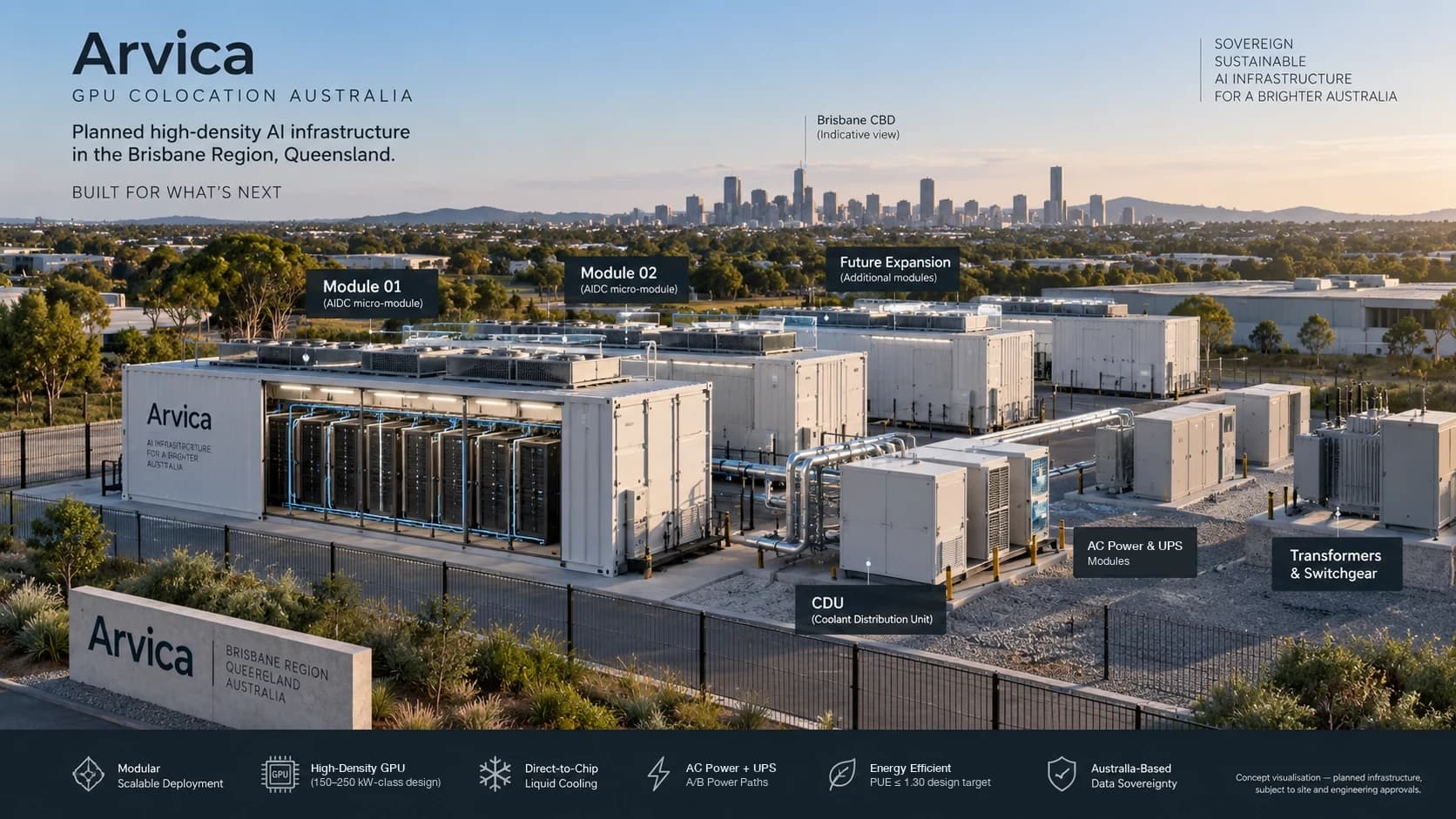
Candidate location: Swanbank, Ipswich — South East Queensland (Brisbane region), Australia — candidate site under assessment, not secured.
Target first-stage operation: 2028 — subject to site, grid connection, engineering and development approvals.
GPU Colocation Australia — High-Density AI Infrastructure
Planned Australian high-density GPU colocation for enterprises, AI teams and GPU cloud operators deploying their own GPU infrastructure.
Planning basis: first stage 600–800 kW IT on a proposed 1.5 MVA grid connection; ultimate target up to approximately 2.2 MW IT on a 3 MVA grid connection — subject to grid connection, engineering validation, site and development approvals. No grid capacity or approval has been secured.
An expression of interest does not reserve capacity or create a payment obligation.
Concept visualisation — planned infrastructure, subject to site, utility and engineering approvals. View full-size concept image ↗PLANNED ARCHITECTURE
Planned Modular AIDC Micro-Module Architecture
The planned facility is designed around prefabricated AIDC intelligent-compute micro-modules deployed in phases. The first stage uses AC electrical distribution with UPS and A/B power paths, direct-to-chip liquid cooling with CDU-based coolant distribution, and supplementary air cooling. An 800V HVDC architecture is reserved only as an optional future provision, subject to OEM demand and equipment compatibility; it is not part of the committed initial design.
AIDC intelligent-compute micro-modulesAC distribution with UPS and A/B paths (first stage)Direct-to-chip liquid coolingCDU-based coolant distributionSupplementary air coolingModular phased expansionAnnual PUE ≤ 1.30 design target800V HVDC: optional future provision only
Architecture, module count, power, cooling capacity and PUE are design targets for a planned development and will be confirmed at final engineering; the PUE figure is a design target, not a measured result, and nothing shown is built or operational.
THREE WAYS TO WORK WITH ARVICA
GPU cloud, dedicated capacity, or colocation for your own hardware
GPU Cloud
Arvica provides the compute: hourly H200, B200 and B300 GPUs, deployed from the portal.
You supply the GPU hardware; Arvica supplies the infrastructure: power, liquid cooling, racks, network, remote hands and an Australian facility.
This page
HIGH-DENSITY LIQUID COOLING
High-Density Liquid-Cooled GPU Racks
Designed for high-density liquid-cooled AI racks, including next-generation GPU systems with power densities far beyond conventional enterprise colocation.
The planned architecture is vendor-neutral direct-to-chip liquid cooling: heat leaves the GPUs and CPUs through cold plates and liquid loops, is collected at rack-level manifolds, and is transferred by coolant distribution units into a separate facility water loop. Components that are not liquid-cooled remain air-cooled in the same rack environment.
Technical schematic — direct-to-chip cooling, rack manifolds, CDU and separated coolant loops (illustrative).
Direct-to-chip cold plates
GPU and CPU heat is removed through cold plates on the hottest components, rather than relying on room air.
Rack manifolds and secondary distribution
Each rack carries supply and return manifolds feeding every liquid-cooled server from a secondary coolant distribution loop.
CDU heat transfer with loop separation
Coolant distribution units transfer heat between the IT coolant loop and the facility water loop, keeping the two separated.
Warm-water operation where supported
Warm-water liquid cooling is targeted where the final engineering and the hardware's thermal envelope support it.
Redundancy in the final design
Redundant pumps and power paths are part of the design intent where applicable; the final redundancy model is set at engineering sign-off.
Residual air cooling
Power supplies, memory, NICs, storage and other non-liquid-cooled components are air-cooled within the same rack environment.
Modular, scalable cooling
Cooling capacity is designed to scale in modules as additional GPU racks are deployed.
Engineering is planned around a future 150–250 kW-class integrated AI rack design envelope, with NVIDIA Blackwell and future Rubin-generation platforms as engineering considerations subject to OEM verification. This is a design envelope, not an operating rack-density guarantee.
Final supported rack density will depend on GPU platform, server configuration, cooling-loop design, utility capacity and commissioning requirements.
PLANNED CAPACITY / EOI BANDS
Expression-of-interest capacity bands
These are planning bands for expressions of interest, not current inventory. They help size the first build phase; every allocation is subject to site, utility, engineering and development approvals.
EOI BAND
50–100 kW
Smaller enterprise AI / GPU clusters
One or more high-density racks for private AI, inference or a first training cluster.
EOI BAND
100–250 kW
NeoCloud / GPU cloud / HPC deployments
Several liquid-cooled racks with room to add nodes as demand grows.
EOI BAND
250–500 kW
Anchor tenant deployments
A reserved block that helps shape the first build phase, with a defined expansion path.
EOI BAND
500 kW+
Custom infrastructure requirements
Dedicated halls, phased power and cooling, bespoke commercial structure.
BRING YOUR OWN GPU HARDWARE
You supply the GPUs. Arvica plans to supply the infrastructure.
Customer supplies
GPU servers and accelerators (HGX B200 / B300, H200 clusters, other high-density systems)
Software stack, orchestration and workload operations
Hardware ownership or lease
Arvica plans to provide
Dedicated power allocation
High-density liquid cooling
Rack and modular infrastructure
Network connectivity
Remote hands
An Australian colocation environment
Reserved infrastructure capacity on a committed term
Typical deployments
AI training clusters and inference infrastructure
GPU cloud and NeoCloud operators
Enterprise private AI
Robotics and simulation infrastructure
HPC
Arvica's role in this product is infrastructure and colocation. Arvica-supplied GPU capacity is a separate service: see enterprise GPU clusters. Enterprise GPU clusters →
DEVELOPMENT STATUS
Where the program stands
Planned high-density GPU colocation at Swanbank in the Brisbane / South East Queensland region. A transparent view of the development program: it is at the site-selection, grid-connection and concept-engineering stage; no stage is complete, no site, grid capacity or development approval is secured, and status is updated as approvals are obtained.
1
Site selection
A candidate site at Swanbank, Ipswich in South East Queensland is being assessed against power, connectivity and expansion criteria. No site has yet been secured.
In assessment
2
Utility capacity assessment
A grid-connection assessment is underway with the relevant utility for a proposed 1.5 MVA first-stage connection and a 3 MVA ultimate target. No grid capacity has yet been secured or confirmed.
Under assessment
3
Electrical and liquid-cooling design
The AC electrical distribution, UPS and A/B power paths and the direct-to-chip liquid-cooling architecture are at concept engineering stage.
Concept design
4
Anchor tenant EOI
Expressions of interest are open and inform the first build phase.
Open now
5
Development
Construction and fit-out follow site, utility, engineering and development approvals.
Planned
6
Commissioning
First-stage commissioning is targeted for 2028, subject to site, grid connection, engineering, development and commissioning requirements. Power, cooling and network commissioning precede customer hardware installation.
You own or supply the GPU servers; Arvica supplies the infrastructure around them: power, high-density liquid cooling, rack space, network connectivity, remote hands and an Australian facility environment. It is distinct from GPU cloud, where Arvica supplies the compute itself.
Can we bring our own B200 or B300 servers?
Yes. The planned facility is designed for customer-supplied high-density systems such as HGX B200, HGX B300 and H200 servers. Supported configurations, rack density and installation requirements are confirmed per deployment at final engineering.
What power blocks is Arvica planning?
The planning basis is a first stage of 600–800 kW IT load on a proposed 1.5 MVA grid connection, with an ultimate target of up to approximately 2.2 MW IT on a 3 MVA grid connection. Both depend on the grid connection, summer load and PUE validation, full electrical and thermal engineering, and site and development approvals. EOIs are collected in 50–100 kW, 100–250 kW, 250–500 kW and 500 kW+ bands.
Is the facility operational today?
No. This is a planned development at the site-selection, grid-connection and concept-engineering stage. First-stage operation is targeted for 2028; this is a planning target, not a guaranteed service commencement date. No site, grid capacity or development approval has been secured, and nothing is built; the development status section shows the current stage.
Is liquid cooling planned?
Yes. The design direction is direct-to-chip liquid cooling with rack manifolds, CDU-based heat transfer and separated IT and facility loops, with supplementary air cooling for components that are not liquid-cooled. The design target is an annual PUE of 1.30 or below; this is a design target, not a measured result. Final supported rack density depends on the final engineering.
Can the infrastructure scale over time?
The design intent is staged growth: modular power and cooling that expand as racks are added, from the 600–800 kW IT first stage towards an ultimate target of up to approximately 2.2 MW IT, within whatever grid capacity and approvals are ultimately obtained.
Can workloads remain in Australia?
That is the purpose of the facility: an Australian environment for customer-owned hardware, with a candidate site at Swanbank, Ipswich, in South East Queensland near Brisbane. State your data-residency requirement in the EOI so that compute, storage and support-access locations are addressed in the proposal.
How do we submit an EOI?
Use the form on this page. It prefills Arvica's enterprise request with your capacity band, platform, density, timing, term and residency requirement; you then add company and contact details. No payment is required and nothing is reserved by submitting.
Can Arvica support an anchor tenant requirement?
Yes. Anchor tenant EOIs in the 250–500 kW+ range help shape the first build phase, including reserved blocks, expansion rights and commercial structure. Terms are agreed in a written proposal and contract.